
Start a Lakewood Residents Directory Search
Lakewood has no single public list of everyone at every address. The useful record depends on the question. Begin a current owner or parcel question in the Cuyahoga County MyPlace property system. Begin a deed, mortgage, lien, or older ownership question in the County’s Official Records Search. A dated occupant question belongs in a directory or newspaper collection, while an estate or court question belongs in the court with the right jurisdiction. A Lakewood residents directory search is stronger when two independent records point to the same person, address, and date.
Property records identify an owner or party to a transaction. They do not make a full household list. A tax mailing address can belong to a trust, attorney, or correspondence recipient outside Lakewood. A historical directory can place an occupant at an address in a particular year, but not necessarily the owner. Keep the source date beside every name, especially when a move, a renamed street, or a common surname is involved.
- Use MyPlace with the address, owner name, or parcel number to locate the Lakewood parcel and its situs address.
- Record the parcel ID and abbreviated legal description before opening the Transfers tab or map.
- Search the Recorder index for the owner or earlier transfer party, then compare the deed description to the parcel.
- For a person already suspected to be registered, use Ohio’s voter lookup with first name, last name, and Cuyahoga County.
- For a past household, consult a dated directory, newspaper index, or archive record, then ask the actual custodian for material that is not online.
Note: A careful residents-directory result identifies the source, date, and record role instead of making an unsupported claim about a household.
Lakewood Resident Records Offices
Lakewood’s resident-record trail crosses city, county, and state custodians. The Fiscal Officer manages the parcel and recording systems. The Board of Elections maintains local registration records, while the City’s departments hold permits and other municipal material. Courts keep their own case files. Choosing the keeper first saves time and avoids a vague request being sent to an office that never created the record.
Fiscal Officer Appraisal
County property system
Cuyahoga County, OH
(216) 443-7300
Lakewood Parcel Clues in MyPlace
MyPlace is the practical starting point for a Lakewood address. Select Lakewood under City, then choose Owner, Parcel, or Address. A result shows the parcel ID, owner, situs, municipality, state, and ZIP. Its tabs include General Information, Transfers, Values, Land, building information, permits, Tax By Year, and document links. The View Map route lets a researcher zoom and click a parcel, but the County says its compiled map data is provided as-is. A deed image or office record controls if an ownership or boundary detail conflicts.
| MyPlace field or view | Use in a Lakewood search |
|---|---|
| City | Select Lakewood before an owner, parcel, or address search. |
| Owner / Parcel / Address | Choose the known input, rather than guessing a household list. |
| Transfers | Capture dates, grantors, grantees, and the path toward older deeds. |
| View Map | Open a known parcel and inspect map context, subject to the County disclaimer. |
A parcel is the County’s identified piece of land. A situs address is its physical street address. The legal description is the lot, subdivision, or other land language that carries the same property across older records. Preserve all three in a Lakewood residents directory log.
A screenshot of the Cuyahoga County Recorded Documents page shows the official recording-office route.
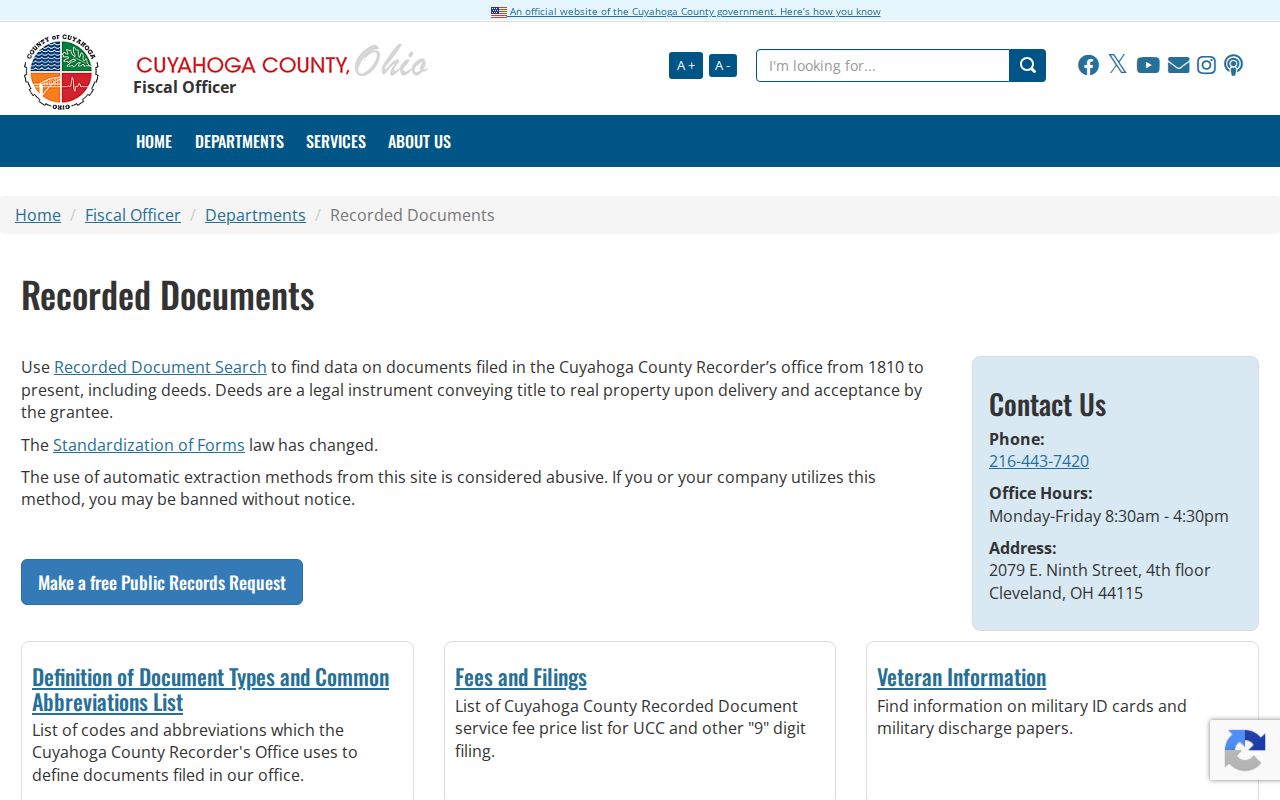
Use MyPlace after a known name or address has narrowed the Lakewood property question, then use the Recorder route for document confirmation.
Lakewood Deed Names Back to 1810
The County states that its online recorded-document search reaches filings from 1810 to the present. Quick Search accepts party names, subdivision, document type or number, and parcel identifiers. Advanced Search adds grantor, grantee, recorded and instrument date ranges, address, parcel, volume and page, and legal-description fields. Enter a party as LASTNAME FIRSTNAME and use a date range when common names create too many results. Parcel IDs use dashes in the County’s displayed pattern.
For an older Lakewood transfer, move from MyPlace’s earliest transfer party to the Recorder, open the deed, and compare its legal description with the parcel. A grantor is the seller. A grantee is the buyer. Deed results can also include mortgages or releases, so document type matters. The local house-research guide also warns that nominal consideration in a deed may not be the actual sale price.
The Cuyahoga Official Records Search is the online source shown here for a party or document search.
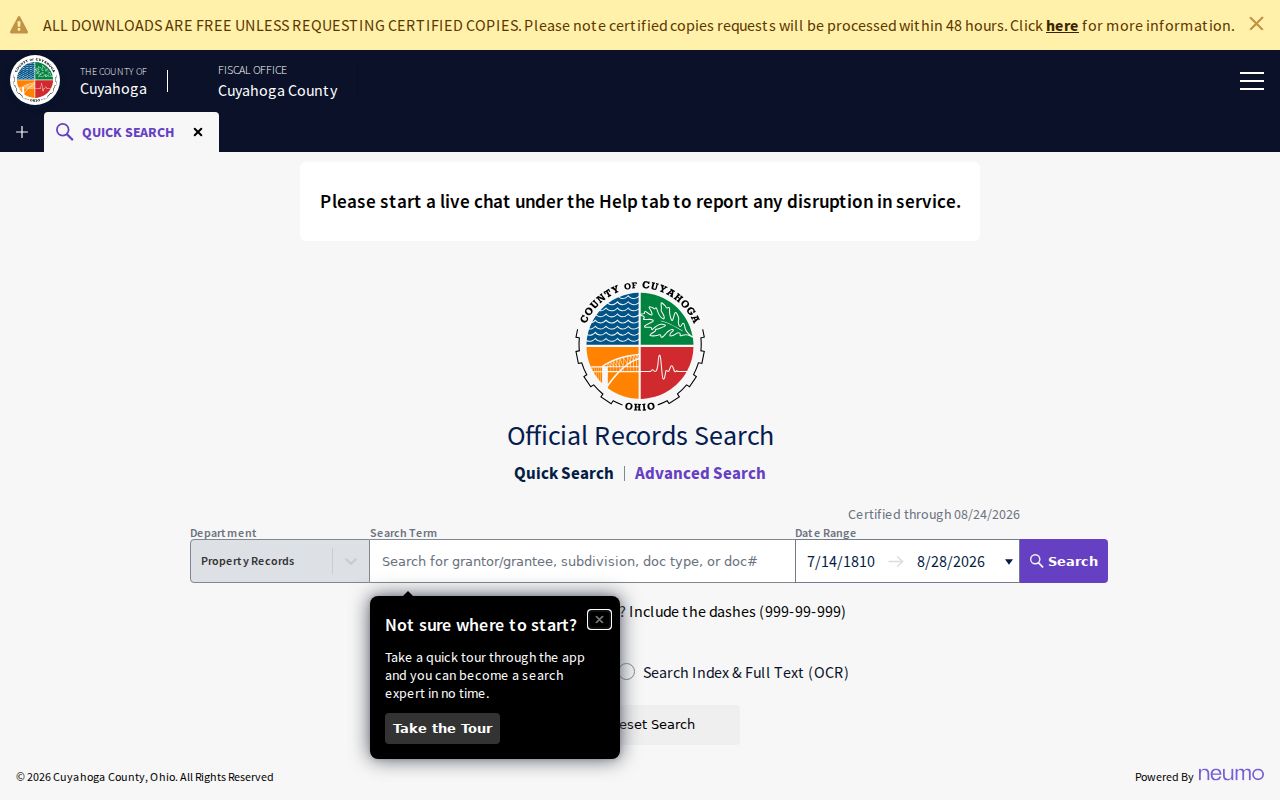
The indexed names supply a transaction trail, not a permanent proof of present residence.
Lakewood Voter Record Checks
Ohio’s Find Voter Information tool is a confirmation route for a person already thought to be registered. It uses first name, last name, county, and Search. A street-name choice may narrow a result after the initial search. For Lakewood, select Cuyahoga County. The Board of Elections is the local contact for registration, precinct, record-maintenance, and lawful file-request questions.
It is not an address census or whole-street roster. Children, noncitizens, unregistered eligible people, inactive records, and protected participants may not appear. Ohio law protects several data classes, and Safe at Home can provide confidential voter registration for qualified participants. A no-match does not prove a person never lived in Lakewood. The state DATA Act portal also offers dated county snapshots, but its retention window makes it a current research channel rather than a permanent historical archive.
Current Lakewood Residents Directory Sources
Current directory-like sources are partial rolls, not interchangeable lists. MyPlace is best for a parcel and named owner. The Recorder captures parties to filings. Voter confirmation is person-based. Court and Probate searches can locate a public proceeding but need a case number and court check. The records-coverage table below helps match a Lakewood residents directory question to the most appropriate public source.
| Lakewood source | What it can confirm | Custodian | Access path |
|---|---|---|---|
| MyPlace parcel record | Owner, situs, parcel, transfer and tax data | Fiscal Officer | Free County portal |
| Official Records Search | Parties, filing date, document type, legal description | Transfer & Recording | Free index and image route |
| Voter lookup | Registration information for searched person | Secretary of State / Board | Official lookup |
| Case dockets | A public case, court, role, and dated event | Relevant court | Court portal or clerk |
| City request records | Identifiable City-held material | City department | NextRequest or custodian |
Official records show the keeper, date, and limited purpose of a record. A paid commercial compilation can be a lead, but it may be stale or combine people with similar names. For a Lakewood residents directory question, confirm the lead with the office that created the record rather than treating a compiled listing as evidence.
Lakewood Court Names by Jurisdiction
Choose the court by case type. Lakewood Municipal Court CaseLook is the local route for Lakewood traffic, misdemeanor, civil, small-claims, ordinance, and related matters. Probate handles estates, guardianships, wills, marriage licenses, and related proceedings. Cuyahoga Common Pleas handles its own General, Domestic Relations, and appellate record groups. Federal matters use PACER. A court result should be checked against case number, party role, date, court, and disposition.
CaseLook’s accessible calendar filters include day, month, year, attorney, and official. A calendar listing can show a party or caption, case number, event type, judge, date, and time. It is an index lead, not the complete file. Sealed, expunged, juvenile, adoption, and other protected matters may be absent or restricted. Request a municipal file from the court clerk, not from the City’s general records portal.
A screenshot of the Cuyahoga Probate Court shows one court route for estate and marriage-related record work.
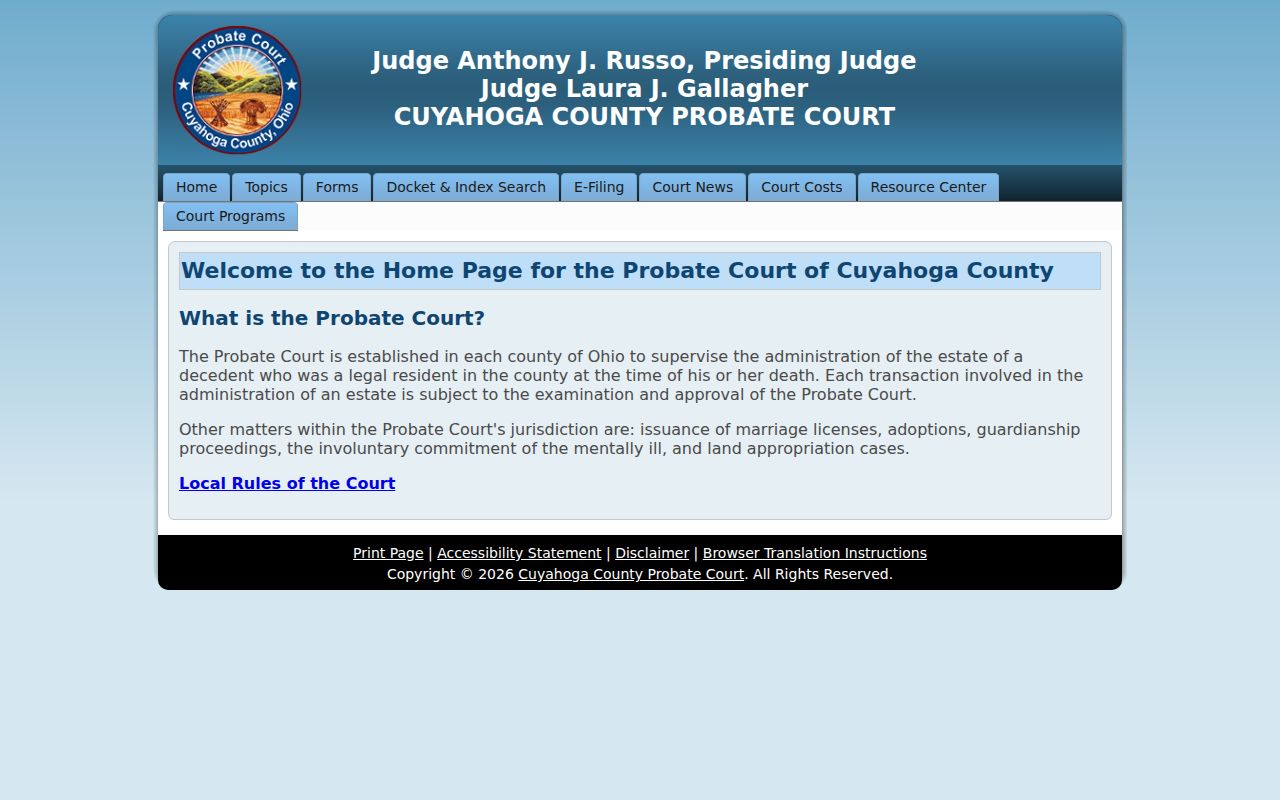
Probate entries need official court verification before they are used in an estate or family-history conclusion.
Lakewood Vital Records Through the City
The Lakewood Division of Vital Statistics issues certified certificates for any Ohio birth and a Lakewood death. It accepts requests by mail, email, fax, or in person, though certificates are not sent by email or fax. The office lists a $25 charge per birth, death, or fetal-death copy. Its office is separate from a name-search directory, so identify the certificate, local event, or historical index actually needed before applying.
Marriage licenses and certified marriage records begin with Cuyahoga Probate. Divorce records are court records. Adoption materials have separate statutory protection. For historical death research, the Ohio History Connection’s index and holdings are different from a certified-copy request. Lakewood’s form is an application for a record, not proof that a person currently resides at a location.
A view of the City vital-statistics page shows the local official record channel.
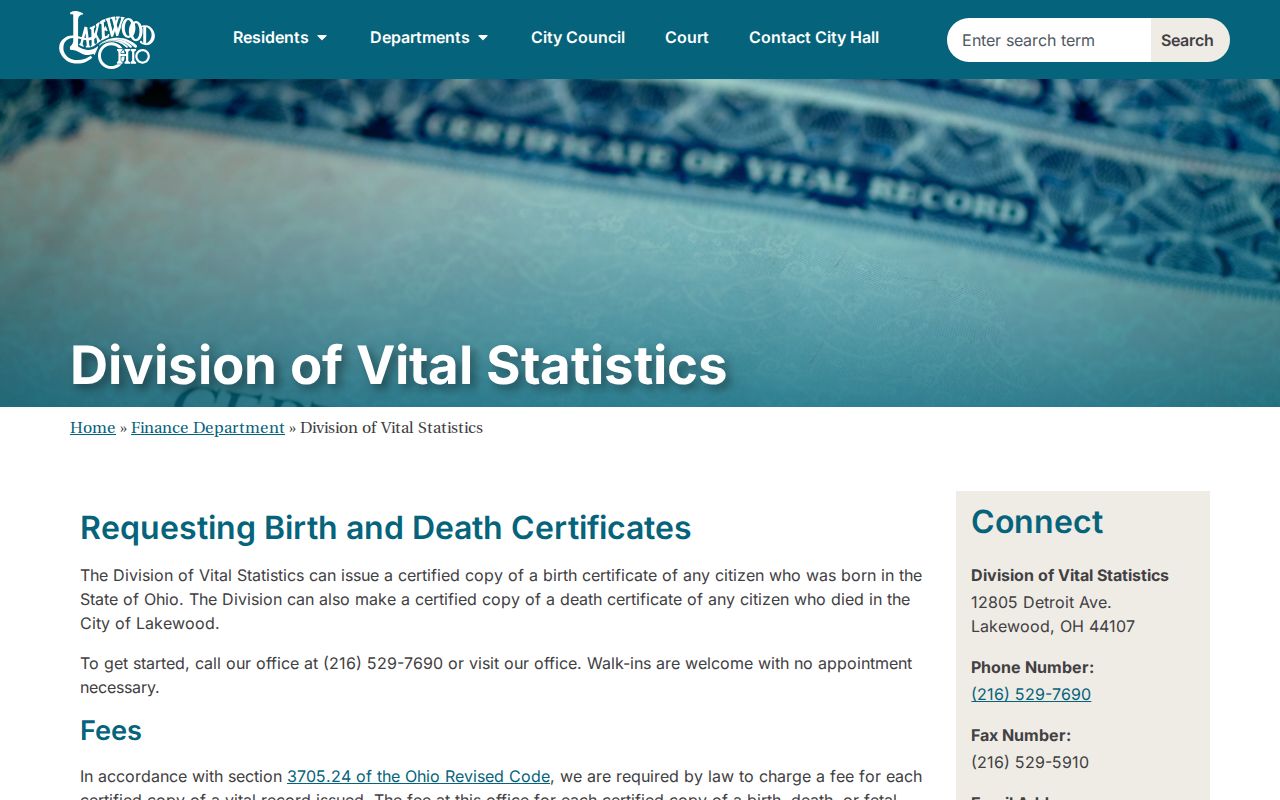
The City channel is useful when the requested certificate and the custodian’s local scope match.
Lakewood Requests That Need a Custodian
Lakewood’s NextRequest portal lets a person inspect prior City requests or submit a new one. The City policy permits requests in person, by phone, or in writing or email. A requester need not state a purpose or identity, but the request must identify a retrievable record. Ask the department to help narrow an ambiguous request. Lakewood lists $0.05 per paper page or $1 for a downloaded computer file on CD, with possible advance copying or mailing costs.
Inspection occurs during ordinary business hours and redaction can occur before copying. The Ohio Public Records Act, R.C. 149.43, generally requires prompt inspection and copies within a reasonable time, but it does not require an office to create new research or compile a custom list. Give the address, record group, date span, and medium. If the City does not hold the record, use the Fiscal Officer, court clerk, Board of Elections, or another actual custodian instead.
A view of the Lakewood public-records portal shows the City’s request entry point.
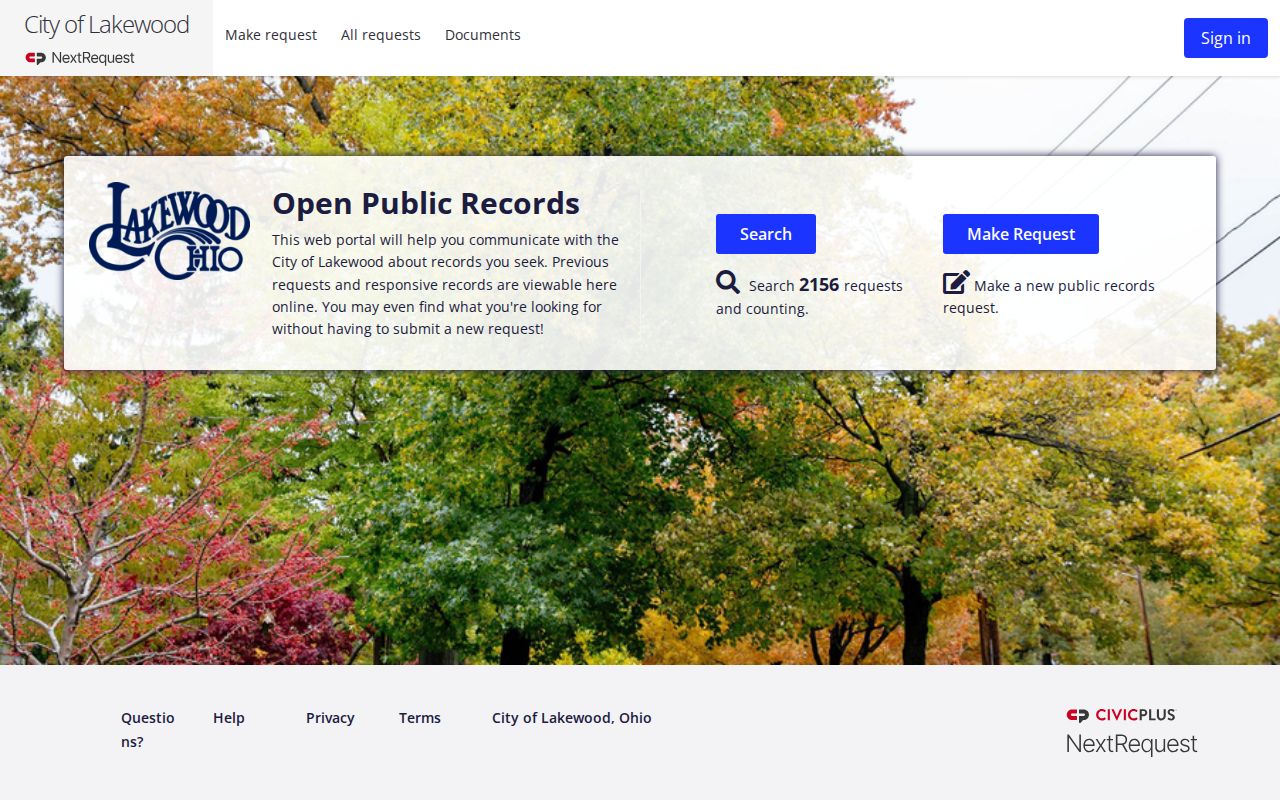
A prior response can offer a lead, but it is not proof that a record is complete or current.
Lakewood House Research Before 1975
Lakewood’s May 2025 house-history guide gives a specific handoff in the property trail. MyPlace transfer history reaches January 1, 1975. Earlier work shifts to the Recorder, Map Room, Cuyahoga County Archives, directories, and maps. County Archives holds tax records from 1819 to 1986, original maps from about 1860 to 1945, and appraisal cards often dated 1944, 1952/53, and 1964. The Map Room supports originals about 1945 forward.
City permit material begins about 1905 and is microfiche in the City Hall basement, available by appointment through the City building office. It can date construction or renovation but does not name every household. This layered route is Lakewood-specific: keep the parcel ID and legal-description abbreviation as an address changes form across a deed, map, directory, or permit card.
Note: The absence of a portal image for an older Lakewood record means use a different access channel, not that the historical record never existed.
Historical Lakewood Residents Directory Sources
Lakewood Public Library holds bound directories in its second-floor reference area. Cleveland directories include Lakewood before the distinct Lakewood series, then Cleveland West Suburban volumes carry later Lakewood listings. Cleveland Public Library documents local Cleveland Directory Co. editions for 1949, 1951, 1953, 1954–55, and 1956 through 1963. Documented West Suburban editions include 1964, 1966–68, 1970, 1971/72, 1973, 1976, and 1979/80. Missing years should remain gaps, not assumed annual volumes.
An address index was added to Cleveland directory volumes beginning in 1929. That creates a useful address-to-occupant route, while an alphabetical listing can help trace a surname. A directory entry often gives a name, street address, and occupation. It may use initials, a spouse convention, or a past address. The complete collection trail is kept on the Lakewood city directories page.
A screenshot of Lakewood Public Library research resources shows the local route to yearbooks, newspapers, genealogy tools, and in-library databases.

Pair a dated directory entry with a parcel or deed when the question requires owner rather than occupant evidence.
Lakewood Privacy and Record Gaps
Public availability has limits. Ohio Safe at Home, R.C. 111.41–111.47, provides address confidentiality for eligible participants and can affect voter and property-related visibility. Ohio voter records exclude protected personal details. Motor-vehicle address data is not a public resident-directory substitute. The Recorder has defined internet-redaction rules, but a request to correct a fact does not erase an accurate public record.
Historical gaps require the same care. The federal 1890 census loss interrupts a useful household comparison. Lakewood’s street record can also change name, including the documented Kirtland Avenue to Bunts Road change. A parcel or legal description is the bridge when a present address and old directory line do not match. Record the spelling used in each source, the source date, and whether the name appears as an owner, listed occupant, party, or court participant. This makes later correction possible and avoids turning a partial Lakewood residents directory result into a claim it cannot support. County Archives, library collections, and the Map Room offer documented fallback paths when the online search ends.