
Start a Lakewood Residents Directory Search
Lakewood keeps no single public roster of every person at every address. The right record depends on the question. Owner and parcel questions begin in the Cuyahoga County MyPlace property system. Deeds, mortgages, liens, and older ownership questions begin in the County's Official Records Search. A dated occupant question belongs in a directory or newspaper collection. Estate and court questions belong with the court that holds jurisdiction. Two independent records can point to the same person, address, and date. That agreement makes a Lakewood residents directory search stronger.
Remember what each record type proves. Property records name owners and transaction parties. They do not list a whole household. A tax mailing address can point to a trust. It can also point to an attorney, or to someone far outside Lakewood. A historical directory places an occupant at an address in a given year. It does not always name the owner, though. Keep the source date beside every name. Moves, renamed streets, and common surnames all invite mix-ups.
- Use MyPlace with the address, owner name, or parcel number to locate the Lakewood parcel and its situs address.
- Record the parcel ID and abbreviated legal description before opening the Transfers tab or map.
- Search the Recorder index for the owner or earlier transfer party, then compare the deed description to the parcel.
- For a person already suspected to be registered, use Ohio’s voter lookup with first name, last name, and Cuyahoga County.
- For a past household, consult a dated directory, newspaper index, or archive record, then ask the actual custodian for material that is not online.
Note: A careful residents-directory result names its source, date, and record role rather than claiming an unsupported household fact.
Lakewood Resident Records Offices
Lakewood's resident-record trail crosses city, county, and state custodians. The Fiscal Officer runs the parcel and recording systems. The Board of Elections holds local registration records. City departments keep permits and other municipal material, while the courts maintain their own case files. Pick the right keeper first, since a vague request sent to the wrong office usually stalls.
Fiscal Officer Appraisal
County property system
Cuyahoga County, OH
(216) 443-7300
Lakewood Parcel Clues in MyPlace
MyPlace is the practical first stop for a Lakewood address. Pick Lakewood under City. Then choose Owner, Parcel, or Address. A result shows the parcel ID, owner, situs, municipality, state, and ZIP, and its tabs cover General Information, Transfers, Values, Land, building data, permits, Tax By Year, and document links. View Map lets you zoom and click a parcel. The County describes its compiled map data as provided as-is, so a deed image or office record controls when an ownership or boundary detail conflicts. Treat the map as a pointer.
| MyPlace field or view | Use in a Lakewood search |
|---|---|
| City | Select Lakewood before an owner, parcel, or address search. |
| Owner / Parcel / Address | Choose the known input, rather than guessing a household list. |
| Transfers | Capture dates, grantors, grantees, and the path toward older deeds. |
| View Map | Open a known parcel and inspect map context, subject to the County disclaimer. |
Three terms anchor every parcel result. A parcel is the County's identified piece of land. A situs address is its physical street address, while the legal description is the lot or subdivision language that carries one property across older records. Preserve all three in a Lakewood residents directory log.
The Cuyahoga County Recorded Documents page displays the official recording-office route for document images.
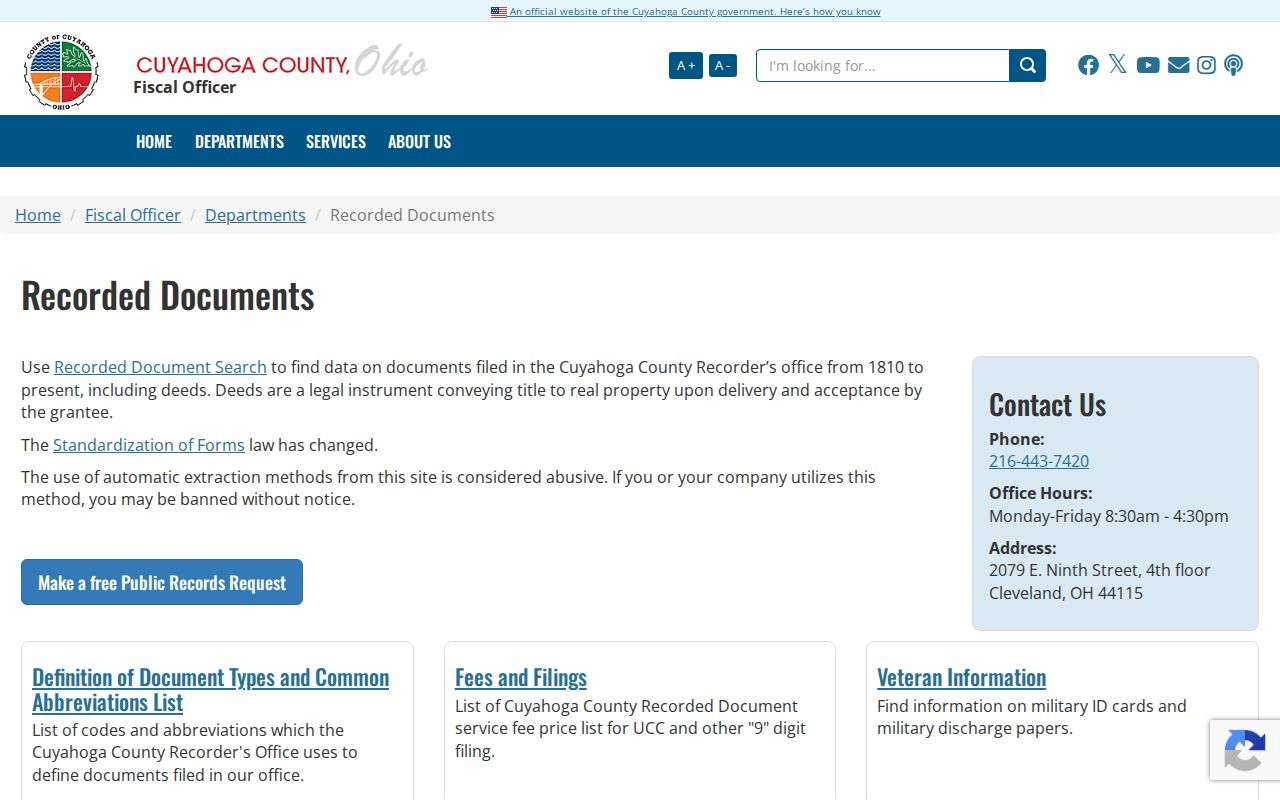
Narrow the Lakewood property question in MyPlace first. Once a known name or address has done that work, use the Recorder route to confirm the document itself.
Lakewood Deed Names Back to 1810
The County's online recorded-document search at the Cuyahoga Official Records Search reaches filings from 1810 to the present. Quick Search takes party names, subdivision, document type or number, and parcel identifiers. Advanced Search adds grantor, grantee, recorded and instrument date ranges, address, parcel, volume and page, and legal-description fields. Enter a party as LASTNAME FIRSTNAME. Add a date range when common names flood the results. Parcel IDs use dashes in the County's displayed pattern.
A grantor sells. A grantee buys. For an older Lakewood transfer, start with MyPlace's earliest transfer party, then open the deed at the Recorder and compare its legal description with the parcel. Deed results can include mortgages or releases too. Document type matters. The local house-research guide warns that nominal consideration in a deed may not be the actual sale price.
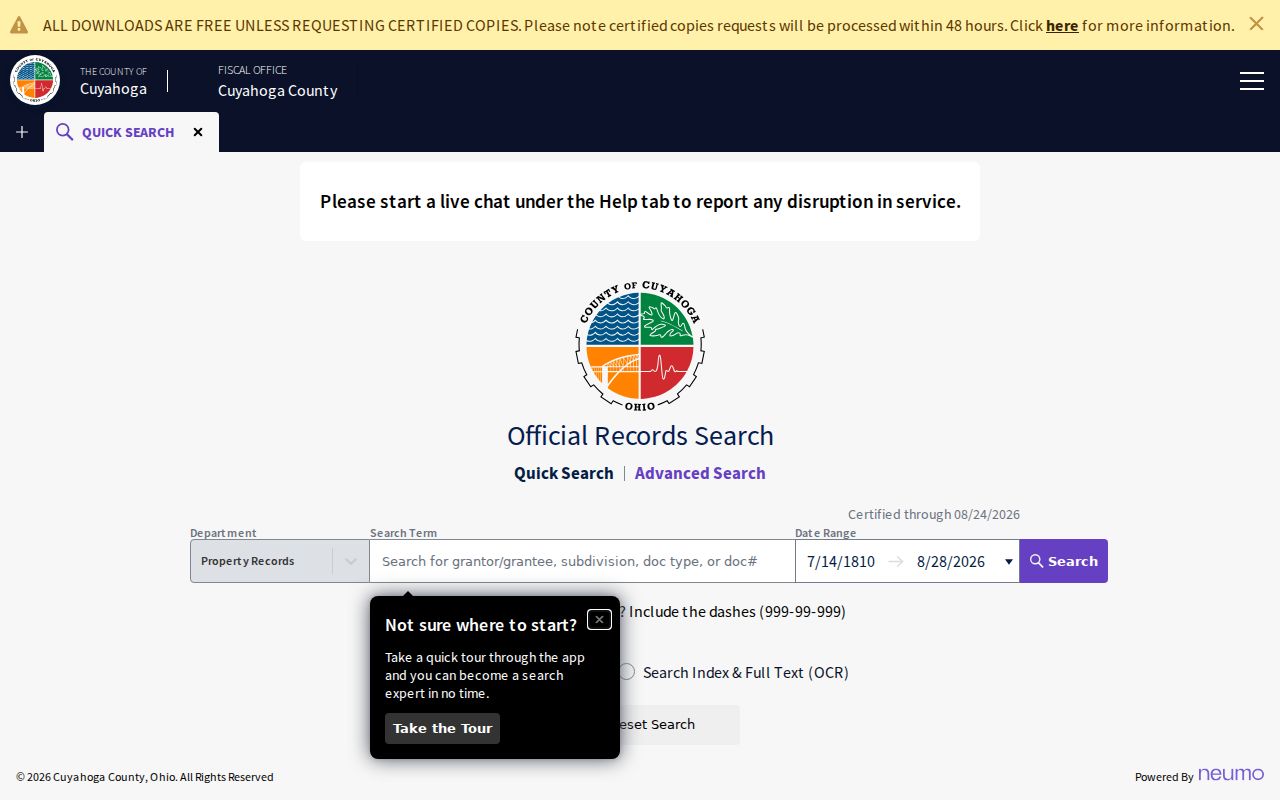
The indexed names supply a transaction trail, not a permanent proof of present residence.
Lakewood Voter Record Checks
Ohio's Find Voter Information tool confirms a person already thought to be registered. Enter first name, last name, and county, then hit Search. A street-name choice can narrow the results. Pick Cuyahoga County for Lakewood. The Board of Elections handles registration, precinct, record-maintenance, and lawful file-request questions locally.
The tool is not an address census or whole-street roster. Children, noncitizens, unregistered eligible people, inactive records, and protected participants may not appear. Ohio law protects several data classes. Safe at Home can shield qualified participants with confidential registration. A no-match does not prove someone never lived in Lakewood. The state DATA Act portal offers dated county snapshots. But its retention window makes it a current research channel rather than a permanent archive.
Current Lakewood Residents Directory Sources
No single list works for every Lakewood residents directory question. Each public source covers one slice of the record. MyPlace ties a parcel to its named owner. The Recorder lists parties to filings, and voter confirmation works by person rather than address. Court and probate searches can surface a public proceeding. But they require a case number and a check with the court. The records-coverage table matches each type of residents directory question to the right public source.
| Lakewood source | What it can confirm | Custodian | Access path |
|---|---|---|---|
| MyPlace parcel record | Owner, situs, parcel, transfer and tax data | Fiscal Officer | Free County portal |
| Official Records Search | Parties, filing date, document type, legal description | Transfer & Recording | Free index and image route |
| Voter lookup | Registration information for searched person | Secretary of State / Board | Official lookup |
| Case dockets | A public case, court, role, and dated event | Relevant court | Court portal or clerk |
| City request records | Identifiable City-held material | City department | NextRequest or custodian |
An official record names its keeper, its date, and its limited purpose. A paid commercial compilation can serve as a lead. Still, it may be stale, or it may blend different people who share a name. For any Lakewood residents directory question, confirm the lead with the office that created the record. Do not treat a compiled listing as proof.
Lakewood Court Names by Jurisdiction
Start by matching the court to the case type. Lakewood Municipal Court CaseLook handles local traffic, misdemeanor, civil, small-claims, and ordinance matters. Probate covers estates, guardianships, wills, and marriage licenses. Cuyahoga Common Pleas keeps its own General, Domestic Relations, and appellate record groups. Federal matters run through PACER. Before relying on a hit, check it against the case number, party role, date, court, and disposition.
CaseLook's calendar filters by day, month, year, attorney, and official. A calendar entry may display a party or caption. It may also list the case number, event type, judge, date, and time. Treat it as an index lead rather than the full file. Sealed, expunged, juvenile, adoption, and other protected matters may be absent or restricted. Request a municipal file from the court clerk, not from the City's general records portal.
The Cuyahoga Probate Court page illustrates one court route for estate and marriage-related record work.
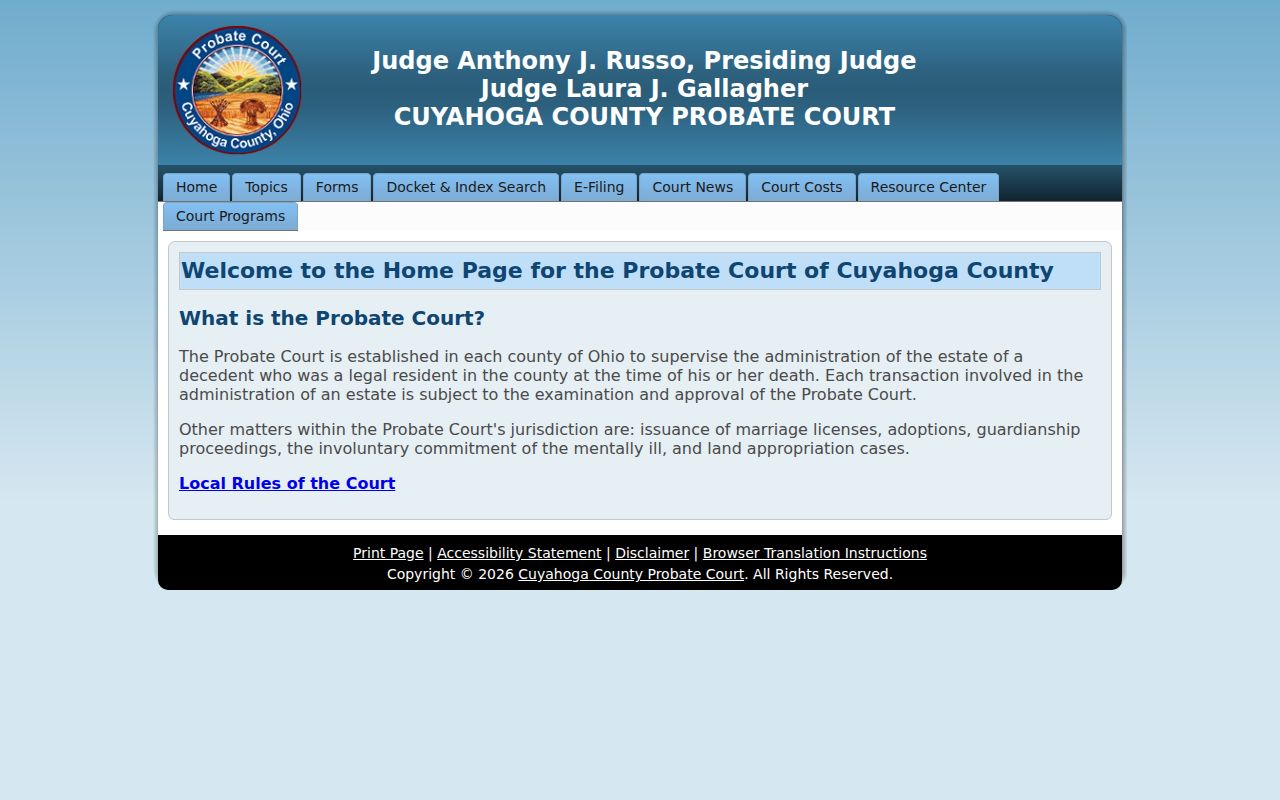
Probate entries call for official court verification before any estate or family-history conclusion.
Lakewood Vital Records Through the City
The Lakewood Division of Vital Statistics issues certified certificates for any Ohio birth. It also handles certificates for a Lakewood death. Requests come by mail, email, fax, or in person. Certificates never go out by email or fax, though. The office charges $25 per birth, death, or fetal-death copy. This office is separate from any name-search directory, so pin down the real target before applying. Is it the certificate, a local event, or a historical index?
Marriage licenses and certified marriage records start with Cuyahoga Probate. Divorce records live with the courts. Adoption materials carry separate statutory protection. The Ohio History Connection's index and holdings differ from a certified-copy request for historical death research. A Lakewood application form requests a record. It does not prove anyone currently resides at a location.
The City vital-statistics page shows the local official record channel.
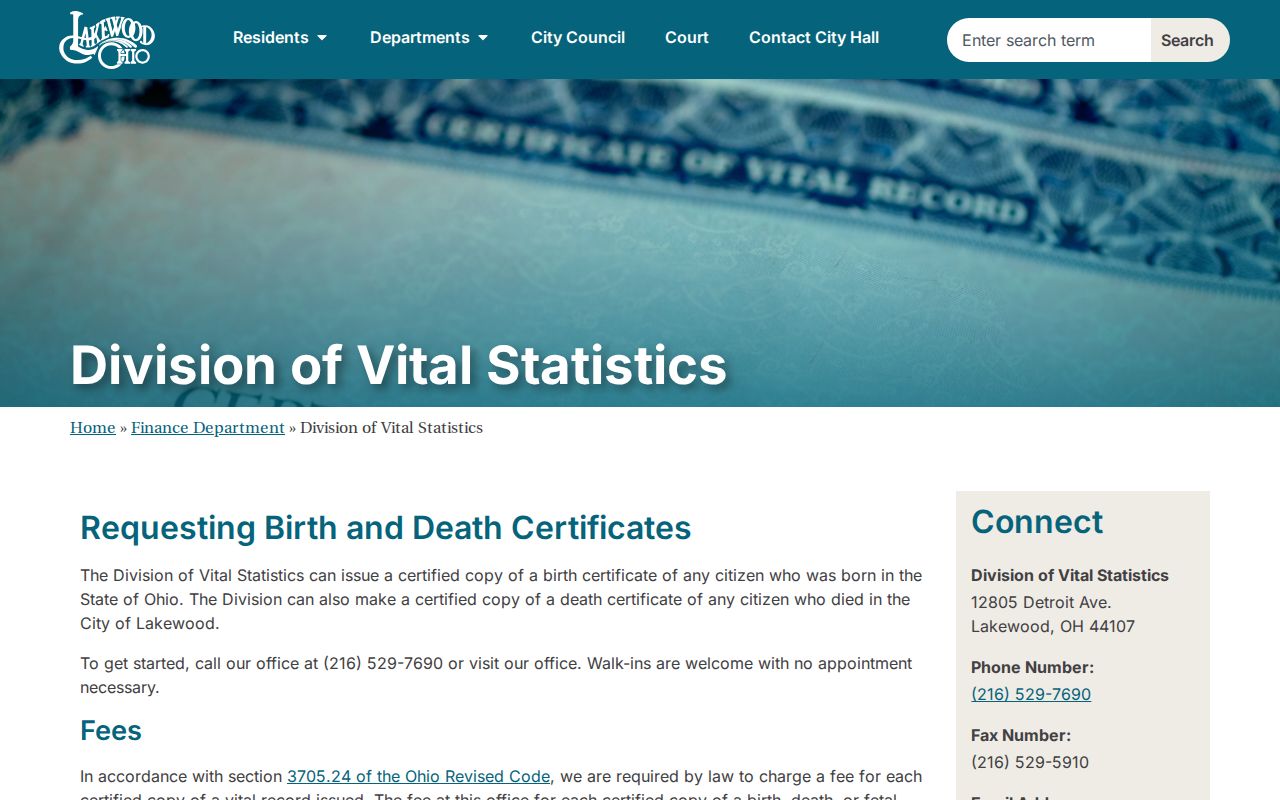
The City channel pays off when the requested certificate falls within the custodian's local scope.
Lakewood Requests That Need a Custodian
Lakewood's NextRequest portal lets anyone inspect prior City requests or file a new one. City policy also permits requests in person, by phone, or in writing or email. A requester need not give a name or reason. The request must, however, identify a retrievable record. The department can help narrow an ambiguous one. Lakewood lists $0.05 per paper page or $1 for a downloaded computer file on CD. Possible advance copying or mailing costs may also apply.
Inspection happens during ordinary business hours, and redaction can occur before copying. The Ohio Public Records Act, R.C. 149.43, generally requires prompt inspection and copies within a reasonable time. It does not force an office to create new research or compile a custom list. Supply the address, record group, date span, and medium. If the City lacks the record, turn to the Fiscal Officer, court clerk, Board of Elections, or another office. Ask whichever office actually holds it.
The Lakewood public-records portal shows the City's request entry point.
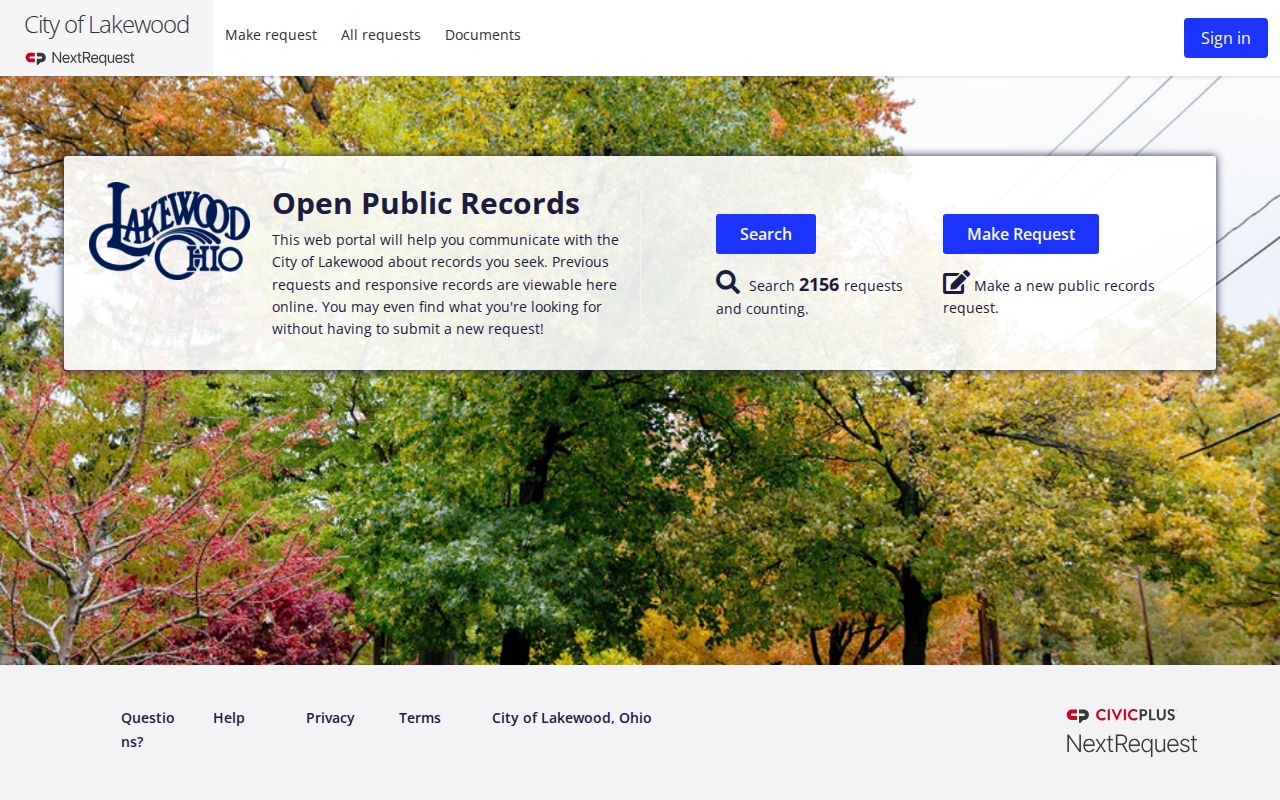
A prior response can supply a useful lead. It never proves a record is complete or current.
Lakewood House Research Before 1975
Lakewood's May 2025 house-history guide marks a clear handoff in the property trail. MyPlace transfer history reaches back only to January 1, 1975. Earlier work shifts to the Recorder, the Map Room, the Cuyahoga County Archives, directories, and maps. County Archives holds tax records from 1819 to 1986. It also holds original maps from roughly 1860 to 1945, and appraisal cards often dated 1944, 1952/53, and 1964. The Map Room supports originals from about 1945 forward.
City permit material starts around 1905. It sits on microfiche in the City Hall basement, viewable by appointment through the City building office. It can date construction or renovation, though it does not name every household. The route is Lakewood-specific. So keep the parcel ID and legal-description abbreviation close as an address changes form across a deed, map, directory, or permit card.
Note: A missing portal image for an older Lakewood record calls for a different access channel. It is not proof the historical record never existed.
Historical Lakewood Residents Directory Sources
Bound Lakewood directories sit in the second-floor reference area of Lakewood Public Library. The story starts with Cleveland, though. Cleveland directories covered Lakewood before a separate Lakewood series existed. Cleveland West Suburban volumes carried the later Lakewood listings. The Cleveland Directory Co. produced local editions in 1949, 1951, 1953, 1954–55, and 1956 through 1963. Cleveland Public Library records document those years. Documented West Suburban editions cover 1964, 1966–68, 1970, 1971/72, 1973, 1976, and 1979/80. Treat missing years as real gaps. Annual volumes should not be assumed.
Starting in 1929, Cleveland directory volumes added an address index. That opens a useful address-to-occupant route for anyone tracing who lived at a Lakewood address. The alphabetical listing still works for a surname search. A typical directory entry lists a name, street address, and occupation. It may show initials instead of a full picture. A spouse convention or a past address may appear instead. Follow the full collection trail on the Lakewood city directories page.
The Lakewood Public Library research resources page lays out the local route to genealogy tools. It also covers yearbooks, newspapers, and in-library databases.

Match a dated directory entry to a parcel or deed when the question turns on ownership rather than occupancy. An occupant listing alone cannot prove who held title.
Lakewood Privacy and Record Gaps
Public access has real limits. Ohio Safe at Home, R.C. 111.41–111.47, shields participant addresses and can narrow what voter and property records show. Voter files in Ohio leave out protected personal details. Motor-vehicle address data is no stand-in for a public residents directory. The Recorder follows defined internet-redaction rules. Even so, asking to correct a fact will not erase an accurate public record.
Historical gaps deserve the same caution. The loss of the federal 1890 census breaks a key household comparison. Lakewood street names can change too. The documented Kirtland Avenue to Bunts Road switch shows this. A present address and an old directory line may disagree. A parcel or legal description bridges them. Note the spelling each source used. Note its date too, and whether a name appears as owner, listed occupant, party, or court participant. That discipline makes later correction possible. It keeps a partial Lakewood residents directory result honest. That result must not become a claim it cannot support. When the online search dead-ends, other options remain. County Archives, library collections, and the Map Room offer documented fallback paths.